Career Development & Competency‑Based Interview Skills
Build evidence, close gaps, and take control of your career

Competency‑based interviews and modern career‑development frameworks all rely on the same underlying skill: being able to understand what a role requires, assess your own evidence against those requirements, and identify where you need to develop further. This course teaches a structured, repeatable method for doing exactly that.
The approach is based on a method recommended by the Royal Society of Chemistry (RSC) for candidates seeking Chartered Chemist (CChem) or Chartered Scientist (CSci) status. We have been delivering this method for over a decade, helping professionals build strong evidence portfolios and take proactive control of their career development.
Participants learn how to analyse job descriptions, person specifications, and competency frameworks, and how to critically review their own experience to identify strengths, gaps, and development priorities. The same method supports both interview preparation and active career management, helping people shape their careers rather than waiting for opportunities to appear.
Why this course matters
Most people approach interviews and career development reactively:
- struggling to recall examples under pressure
- discovering too late that they lack evidence in key areas
- relying on memory rather than structured preparation
This course replaces that uncertainty with a clear, systematic approach.
Participants learn how to:
- understand exactly what a role is asking for
- map their own evidence against those requirements
- identify gaps early — before they become barriers
- prioritise development activities that build real, demonstrable competence
- prepare for interviews with confidence and clarity
This method is equally valuable for people seeking promotion, changing roles, or planning long‑term career progression.
What the course covers
1. Understanding role requirements
Participants learn how to break down:
- job descriptions
- person specifications
- competency frameworks
- behavioural indicators
- organisational values
They learn to distinguish between:
- essential vs desirable
- technical vs behavioural
- explicit vs implied requirements
This forms the foundation for targeted preparation.
2. The Skills Matrix: mapping your evidence
A major component of the course is the Skills Matrix — a structured tool for capturing and organising evidence of your competencies.
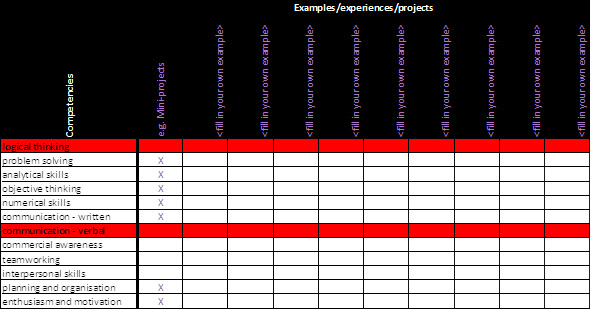
Participants learn how to:
- list required competencies
- map their own experiences against them
- identify where evidence is strong
- identify where evidence is weak or missing
- highlight priority areas for development
The Skills Matrix becomes a reusable resource for interviews, appraisals, and long‑term career planning. Many participants take their matrix into interviews to help them select strong examples under pressure.
3. Identifying development gaps and planning growth
Participants learn how to:
- spot gaps early
- prioritise development activities
- proactively seek opportunities to build missing evidence
- turn everyday work into competency‑aligned achievements
- create a personal development plan grounded in real requirements
This shifts career development from reactive to strategic.
4. Preparing for competency‑based interviews (STAR method)
The course includes practical guidance on answering competency‑based questions using the STAR method:
- Situation – the context
- Task – what you needed to achieve
- Action – what you did
- Result – the outcome and learning
Participants practise constructing STAR answers using examples from their Skills Matrix, ensuring they can give clear, structured, high‑impact responses in interviews.
Who is this course for?
This course is ideal for:
- mid‑career staff seeking promotion or role change
- technical specialists moving into leadership roles
- anyone preparing for competency‑based interviews
- teams undergoing organisational change or restructuring
- individuals wanting a clearer, more proactive career strategy
Our background and experience
We have extensive experience supporting professionals through competency‑based recruitment processes and career transitions. Our method has been used successfully across government, academia, and industry, and is grounded in real‑world recruitment practice.
As an R&D organisation, we understand the challenges of articulating technical work in behavioural terms — and we teach participants how to translate their experience into clear, compelling evidence that aligns with role requirements.
Delivery options
- On‑site or online
- One‑to‑one coaching available
- Can be combined with other professional skills modules
- Suitable for teams or individuals – but works best with groups of 6 or more